
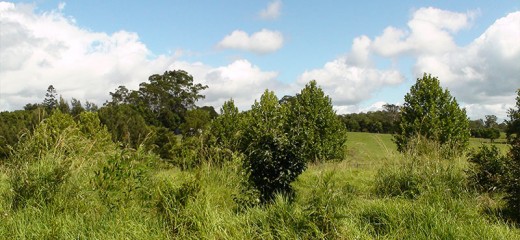
When we first arrived at Synchronicity Farm in 2008 we looked for the best north facing slope on which to commence the planting of a food forest and selected the paddock that was north of the farmhouse for this purpose. The land was previously utilised simply for grazing cattle and was essentially fairly hard packed ground with a moderate level of depth to the topsoil and virtually no insect or organic life asides from some healthy looking worms.
Because the selected location for the food forest was just below the Market Gardens, we found that over a few years, the garden had acted like a sponge, causing water to sit for longer periods and soak in rather than running across the land swiftly back to the river. The result was very
interesting in that as the underground water ‘pocket’ grew bigger, the soil and fertility in the food forest continued to improve.
We noticed changes in the grass structure and vigour, increasing topsoil depth and greater water retention in the upper layers of the planting area. From a design perspective, we have been planting in northerly facing arcs with support trees around the outer edge and the more sensitive fruit trees on the inside. The eventual goal is to then plant bushes to fill all the gaps around the support trees therefore blocking any colder southerly winds. As the protective layer thickens, microclimates can start to be created, allowing warmer areas to exist, therefore helping the fruit trees to be more productive and thriving.
In the food forest so far we have the following planted and we are always on the lookout for more diversity;
In 2015 as many of the trees were getting larger and more established, we started creating fenced areas within the food forest to bring in the sheep and allow for selective grazing. Although we have learned that to keep the animals contained, really good fences are needed, the result was very successful and provided good quality feed for the sheep, while keeping the grass down around the trees although the sheep did try to munch on some lower branches and it became obvious that we would need to protect smaller trees from grazing damage.
Our ultimate vision is to build a fox proof fence and move all of our ducks into the food forest area. We have noted the lower north-west corner of the food forest as an ideal location for a dam that would provide the water and habitat environment that the ducks would really appreciate. From time to time following that we could then use water and duck manure that would collect at the bottom of the dam to be pumped out over the plantings to add valuable nutrients and organic microbial life into the soil.
To provide for future designs, we have installed a significant irrigation system in the food forest that provides for a sprinkler system and taps for watering points which could support many different planting styles. The sprinklers are essentially there to help maintain moisture if times became drier as well as being able to offer some frost protection for younger trees if required. In the past we had lost some young trees planted, due to late frosts in the season.